
Blog & Insights
Running AI in Collections: Governance That Works


This is the third post in our three-part blog series, Responsible AI in Collections: Privacy, Proof, and Practical Guardrails.
In the first post of this series, I argued that explainability is no longer optional: if you can’t explain an AI decision, you shouldn’t ship it. The second post explored how states like California, Colorado, Texas, New York, and Utah are turning that principle into law, naming AI explicitly and spelling out what is and is not allowed.
This final post answers the question teams are now asking in good faith:
How do you actually put AI tools in use with the appropriate governance and continue to be innovative?
Regulators are forcing a shift in operations. Across state laws, we see a theme emerging. They aren’t demanding perfect models; instead, it’s a demand for proving you can control your system.
Across jurisdictions, regulators are converging on a familiar set of expectations:
- You must know what data trained your model
- You must know how the model changed over time
- You must be able to explain its decisions
- You must be able to correct it when it causes harm
Importantly, these laws don’t require you to stop using AI. They require you to operate AI like a regulated system, which you can explain.
Why Point-in-Time Compliance Fails
Many organizations approach AI compliance like a checklist review at release time. But that approach breaks down when models are retrained, rules change, new laws come into play, or consumers exercise their right to appeal a decision made by AI.
Static documentation, one-time bias/fairness tests, and manual disclosures simply don’t scale. Regulators know this, and they’re increasingly asking how controls are actively maintained, monitored, and applied to keep production running efficiently.
The Architecture Pattern That Works
The organizations getting this right are building governance into the system, not bolting it on afterward. This means:
- Version controlled models and data
- Automated disclosures triggered by context
- Built in explainability and appeals
- Continuous monitoring instead of periodic reviews
- Composable controls that can adapt as laws evolve
This is what allows teams to ship confidently, even as requirements change underneath them.
What This Means for Collections and Consumer Finance
In collections and other high-impact financial workflows, AI decisions directly affect people’s access, outcomes, and rights. That’s why regulators are particularly focused on explainability, fairness, human oversight, and auditability.
The risk isn’t just regulatory, but reputational and operational as well. Models that can’t be explained or corrected introduce failure modes that surface at the worst possible moment like an audit, a consumer complaint, or an enforcement action.
Regulatory Guardrails for AI Use
Where Governance Lives, Matters
At Finvi, we designed our platform for exactly this reality: regulated automation at scale. With compliance guardrails embedded in the workflow, our systems make it possible to:
- Disclose AI use clearly and conspicuously
- Audit decisioning and prioritization logic
- Detect and correct disparate outcomes
- Maintain full traceability across data, models, and decisions
- Update compliance logic without breaking production
Governance doesn’t slow you down. It’s what lets you move faster with confidence.
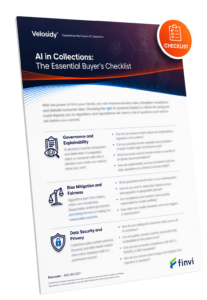
Evaluating AI vendors or capabilities?
AI in Collections: The Essential Buyer’s Checklist includes the key questions teams are asking around explainability, bias, data privacy, and auditability before moving forward.
The Real Takeaway
AI regulation is here. The conversation has moved to a more practical question: can you operate your AI system under real regulatory conditions?
Point-in-time compliance won’t hold up as models change, data evolves, and regulations expand. Governance needs to be continuous, embedded, and auditable by design.
The organizations that succeed will be able to show control at any moment, not just at release. In this environment, the standard is clear: “We can explain our AI system.”
Continue the series
Collections AI: If You Can't Explain It, Don't Ship It → Read the post
New AI Rules for Collectors: What You Can (and Can't) Do, and How to Prove It → Read the post
Get Practical Guidance for AI Compliance and Risk
For a deeper look at the requirements shaping AI use today, visit Finvi’s Compliance and Risk Management hub. You’ll find practical content covering AI oversight, required disclosures, licensing, data privacy, and more — along with tools to help evaluate your current approach and identify potential gaps.
Angela Erwin
As the Vice President Risk and Compliance and a Certified Compliance Receivables Professional (CRCP), Angela plays a pivotal role in navigating the complexities of the risk and compliance landscape. Her expertise enables Finvi’s products and services to be at the forefront of compliance, meeting applicable regulatory, security, and privacy standards. Angela is an internationally recognized compliance innovator and has garnered many professional awards for her achievements within her field. As a recognized national speaker, she shares her insights on critical legislation such as the Fair Debt Collection Practices Act, the Fair Credit Reporting Act, federal and state consumer protection regulations, the Telephone Consumer Protection Act, Americans with Disabilities Act, and the Health Insurance Portability and Accountability Act. Angela’s dedication to excellence, coupled with her commitment to advancing industry standards, cements her reputation as a trusted advisor and thought leader in the risk and compliance arenas.