
Blog & Insights
Outbound and Inbound AI Voice Bots: A Practical Guide to Mitigating Risk


At a high level, inbound AI voice bot interactions present lower regulatory and operational risk than outbound use cases. The reason comes down to who initiates the interaction and the consumer’s level of expectation and readiness.
Inbound Calls: Lower Risk Profile
Inbound calls are:
- Initiated by the consumer
- Typically intent-driven (the consumer is prepared to engage)
- More likely to result in:
- Willing authentication
- Willing consent
- Acceptance of automated interaction (including AI)
Because the consumer is choosing to engage, the risk of surprise, confusion, or perceived deception is significantly reduced.
Outbound Calls: Elevated Risk Profile
Outbound calls are:
- Initiated by the agency
- Require establishing a Right Party Contact (RPC)
- Often reach consumers who are:
- Unprepared to engage
- Unwilling to authenticate or provide consent
- Potentially skeptical of automation
If AI is not clearly disclosed, the risk of consumer distrust, complaints, and regulatory scrutiny increases sharply.
The 5 Key Regulatory Risks in AI Voice Bot Use
1. FDCPA – Right Party Contact & Third-Party Disclosure
Under the FDCPA, contacting the wrong individual can result in an unlawful third-party disclosure.
Risk:
What happens if the AI bot fails to correctly identify the consumer before discussing the debt?
Mitigation:
- Require RPC confirmation before any debt-related disclosure
- Use multi-factor authentication
- Design AI flows to fail safely (no disclosure until verified)
2. UDAAP – Deception, Fairness, and Transparency
You must ensure communications are not unfair, deceptive, or abusive.
Risk:
What if the consumer believes they are speaking with a human because the AI fails to disclose itself?
Mitigation:
- Provide clear and conspicuous AI disclosure at the start
- Monitor for:
- Misleading language
- Tone issues (coercive, threatening, overly persuasive)
- Implement conversation guardrails and escalation paths
3. TCPA – Consent and Artificial Voice Requirements
AI Voice Bots are treated as artificial or prerecorded voice technology under the TCPA.
Consent requirements depend on the type of communication:
- Information messages such as debt collection communications, prior express consent is generally sufficient.
- Telemarketing or advertising content messages, prior express written consent is required.
Risk:
What if the AI Voice Bot places or continues a call without verifying that valid consent exists for that communication channel or method?
Mitigation:
- Capture and store:
- Who provided consent
- When (timestamp)
- How (channel)
- Scope of consent
- Build systems to block voicemails when the appropriate level of consent has not been obtained.
- Enable real-time consent validation before initiating or continuing communication
4. State AI Disclosure Laws
Several states require:
- Disclosure of AI use
- Ability to opt out and speak to a human
Risk:
What if the AI Voice Bot fails to disclose that it is AI and provide a human alternative or end the call?
Mitigation:
- Provide disclosure
- Offer a clear opt-out path in every interaction
- Enable immediate transfer to a live agent
- Maintain state-specific rule configurations
5. Consent Revocation & Do-Not-Call Handling
Consumers may revoke consent through any reasonable means.
Requirements include:
- Honor revocations as soon as practicable (no later than 10 business days)
- Track and enforce do-not-call and communication preferences
Mitigation:
- Maintain centralized suppression and preference management
- Ensure AI recognizes and respects:
- Stop requests
- Opt-outs
- Channel restrictions
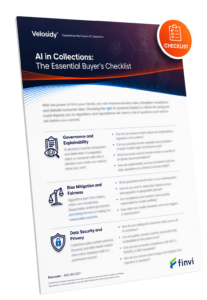
Strong guardrails begin with smart decisions.
AI in Collections: The Essential Buyer’s Checklist can help you identify the capabilities, controls, and safeguards that matter most.
Outbound vs. Inbound AI Voice Bot Risk Classification
Let’s dive into a side-by-side comparison of the potential risks of using AI Voice Bots for Outbound vs. Inbound communication.
| Risk Category / Scenario | Potential Impact | Risk Level | Mitigation Strategies |
| Consumer Harm & Tone
AI uses threatening or coercive language while interacting with consumers. |
Regulatory penalties, reputational damage, consumer lawsuits. | High (Outbound) / Medium (Inbound) | Implement conversation guardrails. Allow human overrides. |
| Right Party Contact
AI discloses the debt to the wrong individual. |
Fair Debt Collection Practices Act (FDCPA) violation with associated fines. | High (Outbound) / Low (Inbound) | Implement strong identity verification. |
| Fair Lending & Bias
AI Voice Bot steers the conversation to a biased settlement offer based on scoring of debts that leads to disproportionately aggressive collection tactics for certain protected classes. |
Fair Lending Act violation, class-action lawsuits, loss of collection license. | Medium (Both) | Conduct regular algorithmic bias reviews to ensure diverse training data. |
| Regulatory Compliance
AI Voice Bot fails to state the required "mini miranda" disclosure. |
Fair Debt Collection Practices Act (FDCPA) violation with associated fines. | High (Outbound) / Medium (Inbound) | Provide mandatory legal disclosures to AI scripts with no option for the AI to alter them. |
| Harassing Conduct
AI Voice Bot calls the consumer more than the allotted frequency or outside of defined calling times. |
Reg F violation with associated fines. State calling frequency violations. | High (Outbound) / N/A (Inbound) | Provide configurable call frequency limitations that the AI system cannot override. |
| Unfair, Deceptive Practices
AI Voice Bot does NOT identify itself and the consumer believes they are interacting with a human. |
UDAAP and State law violations. | High (Outbound) / Medium (Inbound) | The AI Voice bot should identify itself as AI in the beginning of the interaction as well as allow the consumer to opt out of the interaction. |
| Consent Management
AI does not capture or incorrectly captures consent. |
TCPA violation with associated fines. ($500-$1000 per violation) | High (Outbound) / Low (Inbound) | Implement a robust consent capture and audit trail. |
Operational Guardrails for AI Voice Bot Deployment
Given these risks, specifically related to AI Voice Bots in outbound calling, organizations should implement strong operational guardrails to ensure compliant AI deployment.
1. Clear & Conspicuous Disclosure
It’s clear that as a debt collector, you should let the consumer know up front and without a doubt that they are interacting with AI.
At the start of every interaction you can use a sentence like:
“Hi, this is an AI assistant calling from [Company], a debt collector, on a recorded line. Is this a good time to talk?"
This approach has the ability to:
- Meet state disclosure expectations
- Align with global AI transparency trends (EU AI Act)
- Reduce UDAAP risk
2. Opting Out & Human Escalation
The ability to opt out is critical to the consumer. Consumers must be able to:
- Decline AI interaction
- Request a human agent
To provide the best experience for the consumer, consider:
- Offering the ability to opt-out early and often
- Enabling seamless transfers from bot to human
3. Consent Tracking & Documentation
When you track that you have received consent from a consumer to interact with them via an AI Voice Bot make sure you:
| Capture | Avoid |
| Identity of consenting party
Date/Time stamp Channel of consent (voice, digital, written) Scope (AI, pre-recorded, voice) |
Pre-checked boxes
Implied consent assumptions |
4. Reassigned Number Database (RND)
The CFPB provides a safe harbor for agencies that use the RND to ensure that they are talking to the right person. Use the RND to:
- Reduce wrong-party contact risk
- Support safe harbor protections
5. Standard Compliance Still Applies
Remember, regulators have made it clear: when using AI, all the same compliance rules apply.
6. Record Retention
To be prepared for your audits you want to make sure that you maintain:
- Call recordings
- Consent records
- AI interaction logs
Recommended: Minimum of 3 years.
7. Ongoing Monitoring & Model Governance
- Conduct regular QA reviews
- Test for:
- Bias
- Drift
- Script adherence
- Maintain auditability of AI decisions
Stay flexible on guidance
There currently is no over-arching federal law specific to the use of AI in debt collections. There is, however, a growing patchwork of state AI and privacy laws that agencies must adhere to when using AI. Check current guidance to ensure that you’re keeping in sync with these requirements.
Bottom line
AI Voice Bots can deliver significant efficiency gains, but outbound use introduces higher risk than inbound.
You can move forward confidently when you:
- Build strong guardrails upfront
- Implement real-time controls
- Continuously monitor and adapt
Ultimately, success with AI in collections comes down to one principle:
Do the same things you would expect from your best-trained collector — consistently, transparently, and compliantly — at scale.
Stay informed as regulations evolve
Visit Finvi’s Compliance and Risk Management hub for guidance, insights, and resources designed to help you navigate AI, regulatory change, and operational risk.
Angela Erwin
As the Vice President Risk and Compliance and a Certified Compliance Receivables Professional (CRCP), Angela plays a pivotal role in navigating the complexities of the risk and compliance landscape. Her expertise enables Finvi’s products and services to be at the forefront of compliance, meeting applicable regulatory, security, and privacy standards. Angela is an internationally recognized compliance innovator and has garnered many professional awards for her achievements within her field. As a recognized national speaker, she shares her insights on critical legislation such as the Fair Debt Collection Practices Act, the Fair Credit Reporting Act, federal and state consumer protection regulations, the Telephone Consumer Protection Act, Americans with Disabilities Act, and the Health Insurance Portability and Accountability Act. Angela’s dedication to excellence, coupled with her commitment to advancing industry standards, cements her reputation as a trusted advisor and thought leader in the risk and compliance arenas.